
The Strength of the Body–Mind Connection in Empowerment Self-Defense

Three quotes hang on a brick wall in our Center, and one of them reads: “The body cannot go where the mind has not gone first.” I’ve spent a lot of time looking at this poster and thinking about what it means and if I still think it’s true. I do. Mostly.
It makes sense that if you can’t imagine or envision a change for yourself, it’s impossible to take the steps to bring that change into being. If we won’t even allow ourselves to dare, to dream, to design, how can we make? I find this idea incredibly powerful; just imagining is a radical act of creation. Imagining a better job, a more fulfilling relationship, a healthier attitude toward yourself—this is the first step to creating that better reality.
But the mind can also get stuck in negative, unhealthy patterns, and for many of us, imagining is immediately followed by messages like Nice thought, but that’s impossible for me. I’m too weak/scared/stupid/fat/awkward/clumsy/ugly/[insert whatever other horrible thing we say to ourselves] for that better life.
The revelation for me has been that, in some contexts, we can un-stick our minds using the opposite strategy: the mind cannot go where the body has not gone first. Oversimplified, this is the wisdom of “Just do it.” Sometimes not overthinking things and simply putting your trust in your body—for example, continuing to show up to a new class even though you’re terrified—can silence the noise in your head that tells you you’ll never be good enough.
Seeing both these phenomena at work in our Empowerment Self-Defense (ESD) classes has given me new reverence for the connection between our minds and our bodies. In fact, I believe that understanding and using this connection for personal growth is one of the things that makes ESD so vital to both violence prevention and trauma recovery.
When the Body Follows the Mind
I started my martial arts training a little over seven years ago because I was tired of being terrified that I couldn’t protect my children in the event of an emergency. I was nauseated before each class, but I knew I had to go because the idea of failing my kids was scarier to me than the training itself. But every moment of those first months, I was the deer facing down the semitruck, because it had been a very long time since I had any faith in my physical ability.
I have always loved music, so I created a playlist that I listened to on the drive to class: all female punk/indie rock bands, sending me messages that embraced and celebrated power: rebellion, independence, ferocity, strength, sexuality. I began treasuring those 25 minutes in which I imagined my voice to be the defiant shrieks of Karen O or Kathleen Hanna or Louise Post. I carried those voices with me onto the mat. And I kept showing up—a little more self-assured each week.
Very early in all our ESD workshops at Thrive, we talk about how attitude is critical to self-defense: you must believe that you are worth fighting for in order to fight—whether that “fight” is setting a boundary with a loved one or sending a swift palm heel strike to an aggressor’s face. Participants’ voices can be soft and tentative the first time we invite them to say, out loud, “I am worth fighting for.” But each time they repeat the affirmation throughout the class, those voices get stronger.
Other affirmations, delivered as a call-and-response, become the refrain to our group activities: I matter. My voice matters. I am important. My body is mine. In this way, our minds command our voices to express self-worth, and as our voices make those sounds, they literally resonate through our chests, throats, and around the room. And as we hear other participants say the words, too, the collective sound is strong and true. If we all matter, then I must matter too. Affirmations are like warming up a car engine: motion comes so much more easily and smoothly when we take the time to do them.
When the Mind Follows the Body
If affirmations warm up the car engine, striking a pad is like slamming your foot down on the gas.
It’s hard to express in words the look on a woman’s face after the first time she hits a pad. The satisfying and resounding pop that comes from the impact sounds powerful and feels powerful. It’s impossible to deny her capability after hearing that sound and feeling the force move through her own body. This is the best kind of “shock and awe”: She didn’t believe she could, but she did it. No one else helped. She did it. And, maybe for the first time in her life, she knows it.
And so the next time she steps up to strike, she does it with a bit more certainty. And before long, she’s smashing that little black vinyl pad like she never had a doubt.
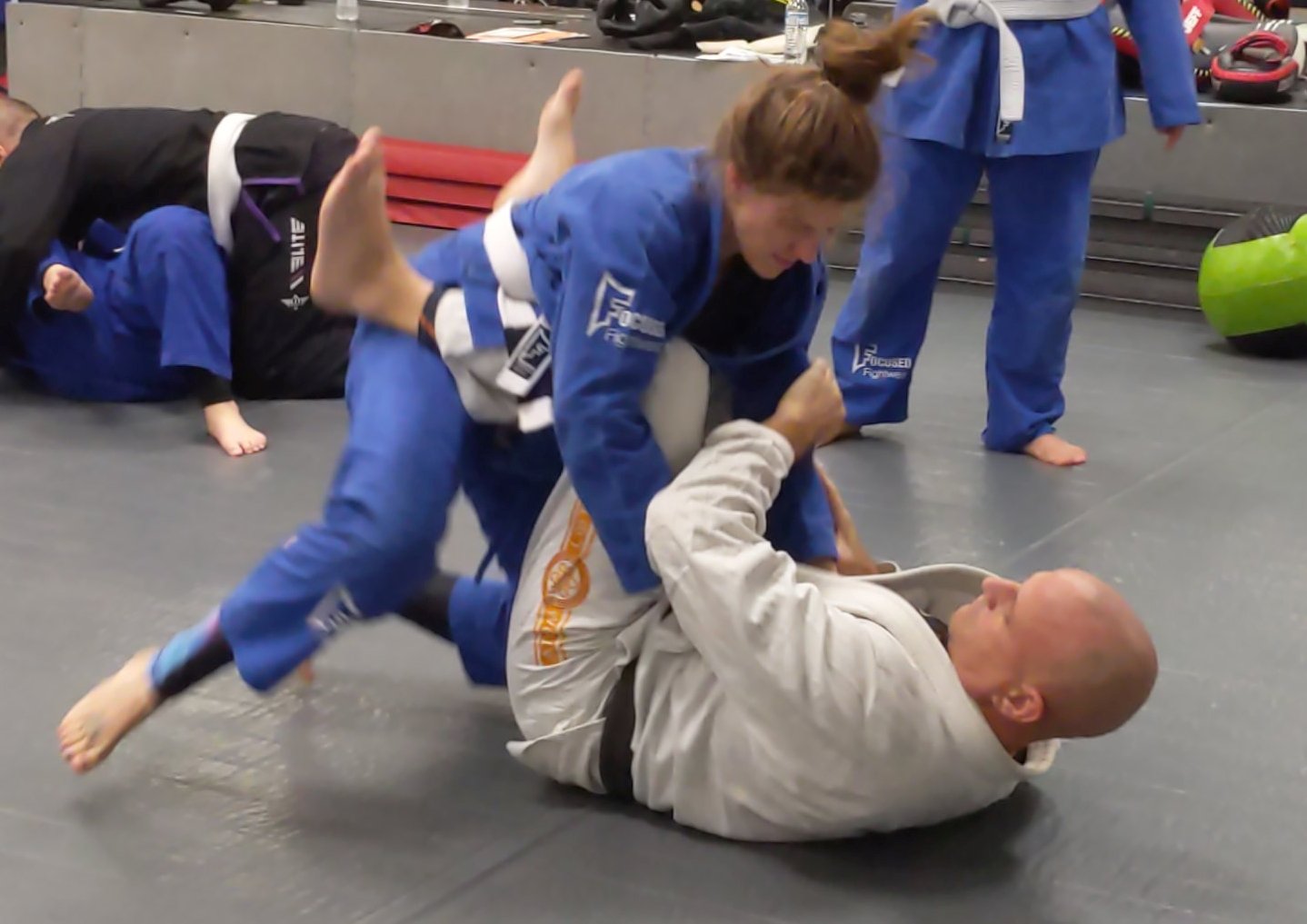
Following your body can be effective in situations where thinking too much leads to fear. I used this technique in my own martial arts training when I started Brazilian jiu-jitsu, a grappling art. More often than not, I am the only woman in the daytime class at my gym, and so in those early months, when my coach yelled, “OK, grab a partner,” my only options were men—unfamiliar, bigger, stronger, more experienced. Yikes.
The trick I used was to just run to the first guy I saw: don’t think, don’t even really look, just go. “Hi, I’m Lauren, will you be my partner?” They always said yes, they were always kind and patient (thanks for the fantastic mat culture, Coach), and even when I spent the whole sparring session with my back against the mat getting the air smashed out of me, when it was over, I was elated. I did it. All by myself. I was brave. Nothing terrible happened. I tried and I learned.
In those moments, stopping to think or to evaluate each possible partner would have led to the paralysis of self-doubt. So I just didn’t give those thoughts space to take hold. My body kept leading me until my mind believed I was safe and accepted.
At this point, I felt like I’d found the secret sauce of empowerment: I trusted my mind to lead me sometimes, and I trusted my body to lead me at other times. Before long, the hard lines between them blurred so much that I finally felt truly present in my training: Mind? Here! Body? Here!
I finally felt safe and whole. And proud of myself.
Using the Mind–Body Connection for Safety and Healing
Safe and whole. That’s the goal we wish for every person who walks onto our mat at Thrive. And we understand that we need to support their entire person if we ever hope to help them achieve that.
Here are several ways Empowerment Self-Defense is different from “traditional” self-defense and works to cultivate and reinforce the mind–body connection:
We spend just as much time addressing cultural, mental, and emotional barriers to safety as we do striking and kicking pads.
We explicitly acknowledge that there are survivors present in every group and affirm the survival strategies they used to bring them to that moment.
We share stories and invite discussion, using the experiences participants relate to build practice scenarios and other connections to the material we’re learning.
Each high-level concept, such as boundary setting, consent, or adrenaline management, is paired with an activity so that action follows idea (or vice versa).
When practicing physical techniques, we invite participants to start slowly—going through the motions at a pace that feels comfortable and increasing power and speed only as they feel ready.
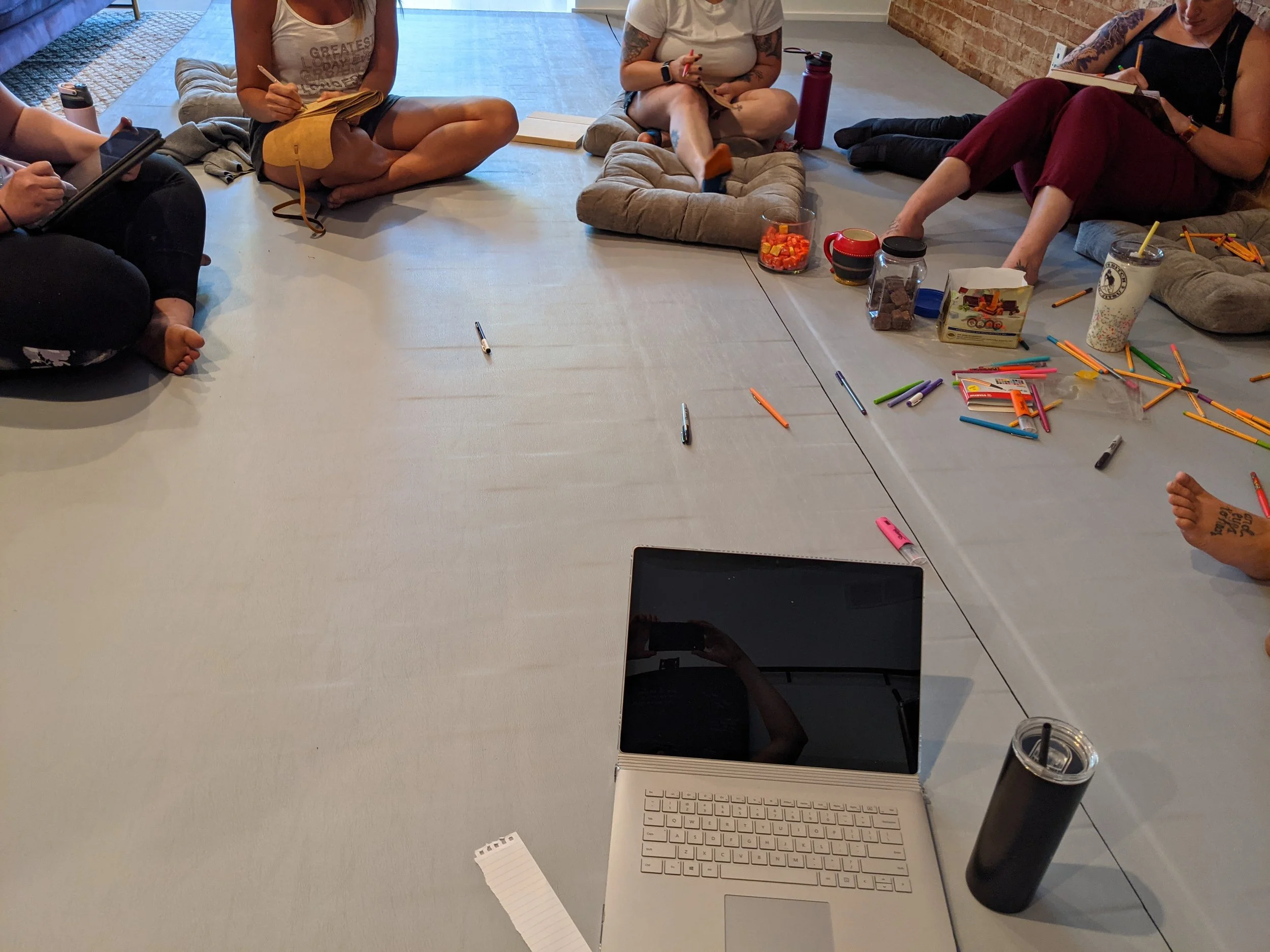
Physical skills lessons are delivered using all four learning styles: visual (watching the demonstration), auditory (listening to us talk through the moves), kinesthetic (practicing the skills themselves), and written (making notes in a notebook).
It’s our intention that these practices allow participants to connect with the material and (re)connect with their own mental and physical selves in whatever way suits them best. Our work is all about providing tools—not telling people what they should do or feel or think. Prioritizing personal agency in a supportive community, ESD bolsters safety and wholeness.
Looking for Opportunities to Practice Connection?
If you’re in the Greater Cincinnati Area, join us for a weekly class focused on the mind-body connection.
Body First: Try Punch It Out! or Body Love
Mind First: Try Writing Reconnection or Body Love