
My Body, My Self
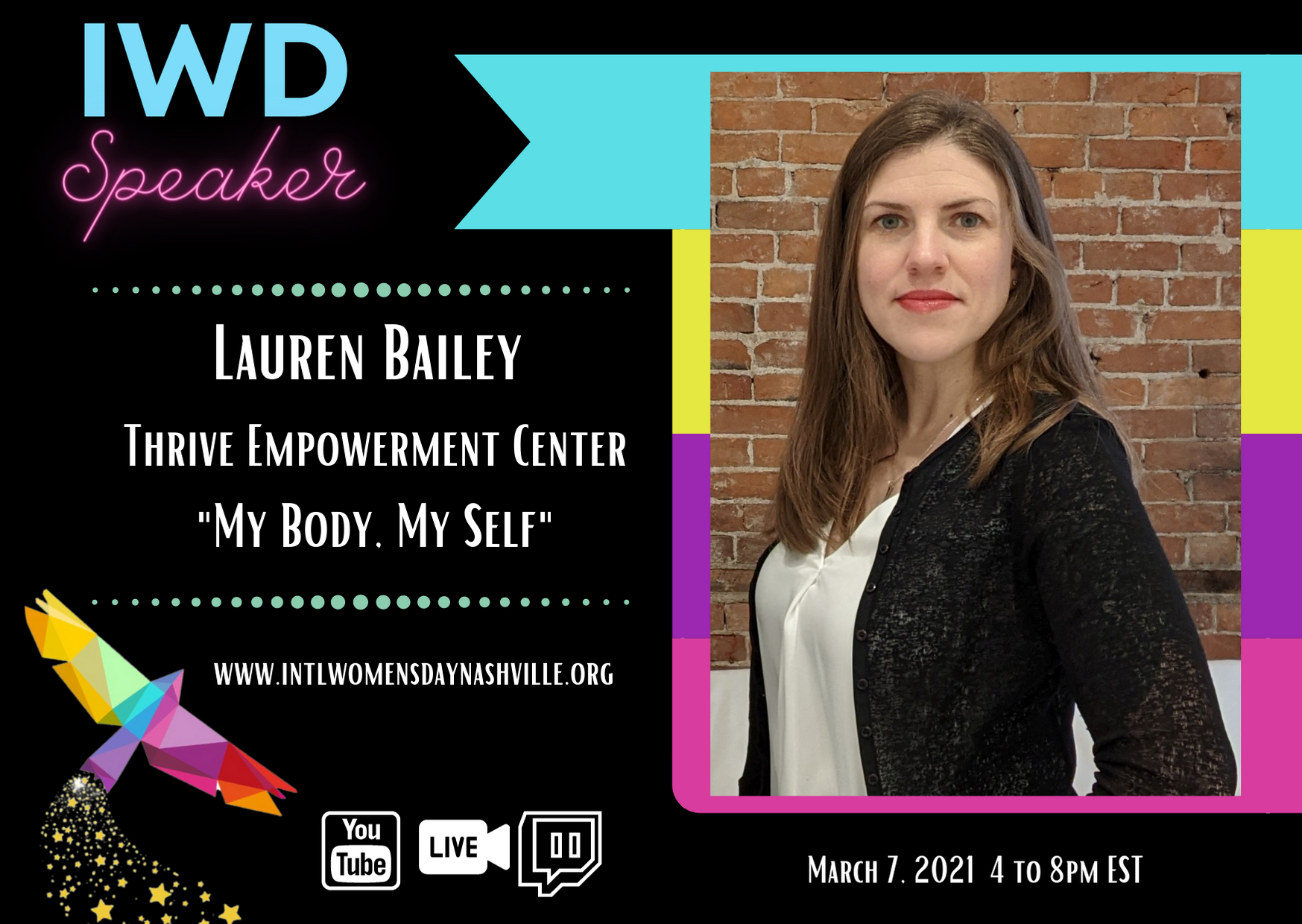
The following is the text of Lauren’s 2021 International Women’s Day talk.
Trigger warning: Depiction of eating disorder
So many of my earliest memories of my body are scenes of humiliation.
If you were a child of the 1970s or 80s, you probably remember the Presidential Fitness Test program. For those of you who didn’t suffer through this, it was essentially military training exercises for elementary schoolers.
I’m about 7 or 8 years old, lining up in front of the monkey bars—my teacher, with clipboard and stopwatch; my schoolmates, a silent jury. The crushing dread as my turn inched closer. In my memory, I am the only kid in my class who can’t lift my body weight so that my chin is the required number of inches above the bar. I don’t know if that’s true; it doesn’t really matter. I got the message: my body is heavy and weak. A source of embarrassment.
I carried that shame over to my playdates, where I began to notice my friends’ taller, leaner, willowy bodies. I measured them with my eyes and then scrutinized myself: broad shoulders, round hips, round butt, soft middle.
Some evenings, when I snuggled next to my mom on the couch, we would pore over the women’s catalogs from our mailbox, marveling at the perfection of these angelic bodies and laughing while we tore our own bodies apart. These magazine bodies were the kinds that clothing was made for. I recognized that the bodies my friends matched the bodies of these grown women. The message was reinforced: My body is heavy, weak, not beautiful.
Around the same time, my father moved out for good. He still dropped by once or twice a week to visit, but each time he left, my mom would retreat to her room to cry while my little brothers and me sat in stunned silence. I’m not sure if that’s when my mom stopped eating and started exercising at a horrific place called Slender Lady, but that’s when I started taking notice. Here’s what I learned: When people stop loving you, it’s probably because your body isn’t good enough. Also, grown women only need to eat once a day, and it’s at dinnertime. Also, when your family is falling apart, you CAN’T TELL ANYONE.
By the time my preteen years arrived, my hips and breasts were even rounder, and the emotional yo-yo my parents had me tethered to had made me furious. “Throw him out and change the locks,” I raged. My rage went nowhere, and worse, it seemed to hurt my mother and brothers more because it threatened our protective silence. I got the message: Shut up. Stop making trouble.
The rage went nowhere. Except it curled back on itself like a tidal wave and swept me under. It was clear to me that I could depend on no one but myself, and if that was true, then I had to be the BEST self. Thin, tough, brilliant, untouchable. Perfect. The only obstacle in my path was that the body I lived in was a failure. I looked in the mirror and my mind said, Nemesis. I vowed to bend that weak, fat, furious crybaby to my will.
I was already embarrassed to be seen eating; I hid my sandwich and carrot sticks in my brown paper bag and retrieved them a nibble at a time, so my friends couldn’t judge what I didn’t deserve to eat.
To solve that problem, I just stopped eating. I was in charge of looking after my brothers while my mom worked, and grown women were strong enough that they didn’t need food anyway. No breakfast. No lunch. Sometimes just bread for dinner since I was tired after basketball practice and I had homework to do.
I pushed myself hard in the classroom and on the court. I excelled in academics but was only a member of the practice squad for our team. I didn’t have the energy to run as fast as the starters; I couldn’t concentrate well enough to pick up new plays quickly. “You’re the dumbest smart kid I know,” my coach yelled.
I was never going to be MVP, but those hours of wind sprints and scrimmaging on an empty stomach garnered the only award I ever really wanted: I was thinner. I started getting compliments. I had a steady boyfriend who played varsity. I was graduating top of my class. It looked like I was winning.
So I kept going through college and grad school. I exercised every day, sometimes for hours, and allowed myself to eat only enough to fill the center of a dessert plate. My willpower was iron. I was a 6. A 4. A 2. A Zero.
I lived on coffee, cigarettes, beer, and granola bars, and I had blinding headaches nearly every day. I was fortunate enough to have a grad school boyfriend who gently nudged me to see a therapist on campus. With her help, and the help of two more amazing women therapists after I graduated, I started to peel away the years like onion skin. The tears that came washed away all those secrets and all that rage, but without taking me along with them.
I didn’t realize that my second therapist specialized in eating disorders. It wasn’t until I saw my story reflected in her face that I even realized that’s what I had. What I’d been doing wasn’t the victory of an iron will; it had a name. And it was a pretty common response to a chaotic childhood. She gave me books to read and homework, something I’d always been great at: a single piece of paper torn from a yellow legal pad, with what was a normal, healthy amount of food to eat each day.
Now I had an academic solution to the problem of my body, and I was excited. My mind had gotten my body into this mess so I was convinced it could get me out.
The dissociation of the mind and body is a well-known effect of trauma. If you’ve studied psychology or the aftermath of violence at all, you’ve probably heard stories of rape survivors or combat veterans who were able to detach and allow their consciousness to float above the horrific scene their body was living. It’s a powerful evolutionary means of self-protection. The correlation between issues of personal control (such as feelings of helplessness and futility) and disordered eating is also well documented. I had separated my mind and my body and pitted them against each other. The only way back to health was wholeness. But I didn’t fully understand that yet.
Reckoning came in the form of two beautiful, healthy children. Balanced nutrition became my focus. This wasn’t about me; it was about making sure my kids were growing and thriving. Tucked behind my overwhelming love for them was a whisper of wonder, “Body, after everything I put you through, you could still do this for me? You could still make these gorgeous tiny humans?”
For the first time in my life, I recognized the strength and goodness in my body. I felt gratitude and appreciation.
I no longer hated my body, but I was still pretty far from trusting it. A new anxiety settled in: What if my little ones needed me to protect them and I couldn’t? What if the house caught on fire or we had a home invader, and I just froze?
My husband’s job took him out of town 5 days out of every week, and I spent months of sleepless nights worrying about failing my kids. One such night, I’d decided I’d had enough. I sat up in bed and dropped an F Bomb out loud into the darkness. I was going to find a women’s self-defense class, because training would give me an action plan and increase my chances of pushing through the freeze.
I had never studied martial arts or thrown a strike in my life, but on a frigid February night, I drove to a tiny strip-mall dojo. There, I got my first lessons in actual assault statistics, situational awareness, and risk assessment. Then I learned how to break a tight grip on my wrist with just a simple circular motion—the rest was a blur of excitement. I could do this! That night lit a fire in me I’d forgotten I’d ever had.
I signed up for a weekly class, and each session brought a physical challenge I’d never before faced. But I kept returning, and as the months passed, I noticed that my mental tapes had changed. I approached each new technique not with assumptions of failure but by saying, “I’ve never done this, but I’ll try.” That gave me permission not to be perfect. It didn’t matter if I failed, as long as I got back up.
The warrior spirit that martial arts awakened in me made positive impacts on other parts of my health. I was back in the gym, but this time with a focus on strength and endurance so I could spar with my male classmates. I ate with an eye on protein, vitamins, and minerals and never stepped on a scale or counted calories once. And, surprise, surprise, my weight finally stabilized and I actually liked what I saw in the mirror. Now, when a self-critical thought tries to creep in, I can easily push it away, pull on my rashguard and gi, and wink at the woman in the mirror.
I’m 42 years old now. I have stretch marks, forehead wrinkles, temperamental knees, and ankles that sometimes lock up just because. But I have escaped from the chokeholds of men twice my size, I’ve survived more than one shark-tank sparring round, and most importantly, I have found a place where my mind and body work together, where I can be my whole, true self.
I know striking and grappling aren’t for everyone, so I urge you to find the place where you can be whole. Some of my sisters have found that place on a dance floor, or a yoga mat, or a hiking trail, or clinging by their fingertips to the side of a boulder. Wherever it might be for you, find the movements of your body that set your mind at ease, the place where your self-criticisms can be replaced with appreciation. The place where your body and your self are one.
—Lauren